TL;DR
A 12x12x2 is not a safe substitute for an 11.25x11.25x2. The labels differ by 3/4 inch, but the actual frames differ by 1/4 inch in each direction, twice the 1/8-inch tolerance filter makers allow. Forcing the larger filter bows its frame, and a smaller filter in a larger rack leaves gaps. Either way, air skips the filter, so buy the exact size.
Key Takeaways
• A filter's printed size is nominal. The actual frame is trimmed slightly smaller so it slides into the rack.
• An 11.25x11.25x2 measures about 11.25 x 11.25 x 1.75 inches, while a 12x12x2 measures about 11.5 x 11.5 x 1.75 inches.
• That 1/4-inch difference is double the standard 1/8-inch cutting tolerance.
• In a published test, a 1/4-inch gap let 18.7% more particles bypass the filter.
• Measure the empty rack as well as the old filter, because the old filter may have been the wrong size.
Will a 12x12x2 Filter Fit an 11.25x11.25x2 Slot?
In most racks, no. A 12x12x2 has an actual frame of about 11.5 inches, which is 1/4 inch too wide and too tall for a rack built around an 11.25-inch filter.
The confusion comes from labels. The 12x12x2 label is a rounded nominal size, not the filter's actual size, while the 11.25x11.25x2 label already matches its frame. The 3/4-inch difference on the box becomes 1/4 inch in your hand, and filter makers treat about 1/8 inch as the acceptable tolerance.
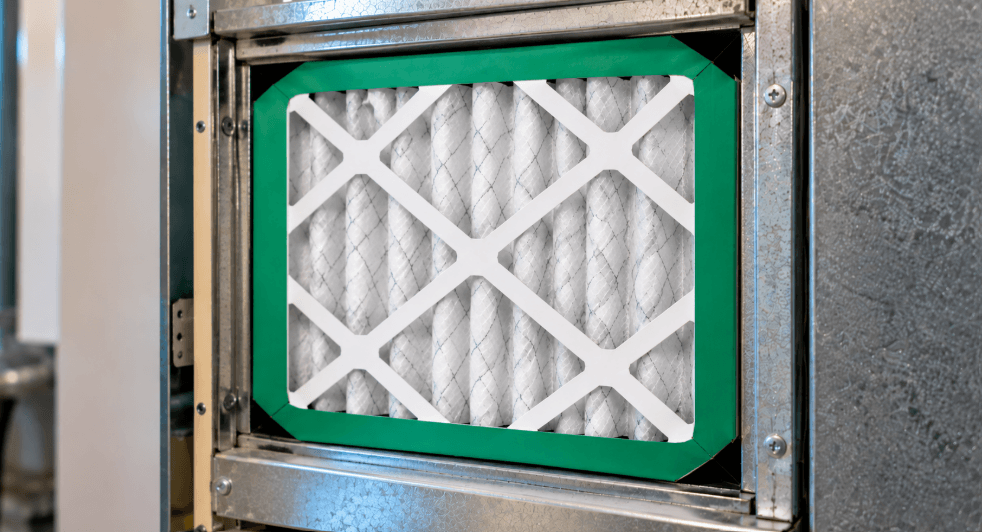
Forcing the larger filter in causes three problems. The frame bows and breaks its edge seal at the corners. The pleats pinch, losing surface area and clogging faster. Some access panels also won't close, which pulls unfiltered air in around the door.
"A filter's fit is just as important as its brand or MERV rating."
How Much Does a 1/4-Inch Fit Error Matter?
Enough to measure. In a published in-house test, two identical HVAC units ran the same filter, one sealed tight and one with a 1/4-inch gap on all sides. After 30 days, the gapped system showed 18.7% more particles bypassing the filter, a 9.4% drop in airflow efficiency, and 20% more dust inside the unit.
The geometry explains why a forced fit fails. An 11.5-inch frame has about 132 square inches of face area, while an 11.25-inch opening holds about 127, so roughly 5.7 square inches, or 4% of the opening, ends up in a bowed frame.
Can I Round Up My Air Filter Size?
Only from a measurement to a label, never from one label to another. If your old filter measures 11.5 inches, its nominal size is probably 12. If its label already reads 11.25x11.25x2, rounding up to 12 creates the fit problem above.
The reverse substitution fails too. An 11.25-inch filter in a rack built for a 12x12x2 leaves about 1/8 inch open on each side, roughly 5.7 square inches of bypass in total. Fit guidance notes that gaps as small as 1/8 inch create bypass channels at any MERV rating.
When Is a 12x12x2 the Right Choice?
A 12x12x2 is right when the rack was built for it. If your old filter says 11.25x11.25x2 but the empty rack measures closer to 12 inches, a previous owner may have been buying an undersized filter. Let the rack measurement decide:
• About 11.25 to 11.5 inches: buy 11.25x11.25x2.
• Closer to 12 inches, with the old filter sliding around loosely: a 12x12x2 may be correct. Confirm with the equipment manual or an HVAC technician.
• Either way, keep the 2-inch depth. Both sizes are about 1.75 inches deep, and a 1-inch filter in a 2-inch slot won't seal.
What Does a Wrong-Size Filter Cost You?
It costs filtration first and energy second. The U.S. Department of Energy notes that air bypassing the filter can deposit dirt directly on the evaporator coil, reducing its ability to absorb heat. DOE also estimates that replacing a clogged filter with a clean one can cut air conditioner energy use by 5 to 15 percent, and a leaking filter lets dirt reach the coil even when the filter is new.
How Can I Tell If a Wrong-Size Filter Is Installed?
Pull the filter and look for signs of bypass: a bowed or twisted frame, dust streaks on the rack or ductwork past the filter, a clean center with dirty edges on the downstream side, or an access panel that won't latch flat. Any of these means you should re-measure before buying the next pack.
How Do I Measure for the Right Filter Size?
Measure both the old filter and the empty rack to the nearest 1/8 inch. This guide to measuring your old filter and slot covers the basics:
1. Turn off the HVAC system.
2. Remove the old filter and note its printed size and airflow arrow.
3. Measure the filter's width, height, and depth.
4. Measure the empty rack opening.
Compare your numbers to the listed actual size, not the label. A correct filter slides in with light finger pressure and sits flat on all four edges. If you see a gap at a corner or have to push, measure again.
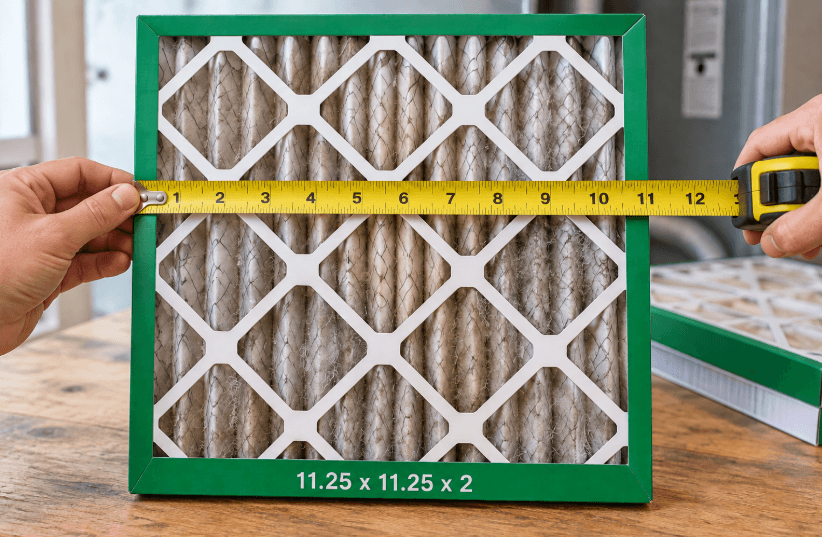
Where Can I Buy an 11.25x11.25x2 Filter?
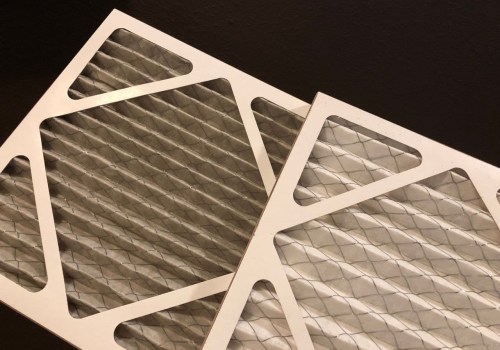
Online filter manufacturers are the most reliable source, because many big-box stores don't stock odd sizes. An 11.25x11.25x2 pleated filter in MERV 8, 11, and 13 at an actual size of 11.25 x 11.25 x 1.75 inches.
Filterbuy is a U.S. air filter manufacturer based in Talladega, Alabama, that makes pleated HVAC and furnace filters in more than 600 standard and odd sizes. Its 11.25x11.25x2 filter is made in the USA and ships within 24 hours, according to its product page. On September 23, 2026, a 6-pack was listed at $13.33 per filter, about $53 a year with 90-day changes.
If you need a filter today, don't force in a 12x12x2 and don't run the system without one. A filter that isn't badly clogged can stay in place a few extra days while the right size ships.
Essential Resources on 11.25x11.25x2 Air Filters
1. Buy the Exact 11.25x11.25x2 Size Instead of Settling for 12x12x2
Filterbuy's 11.25x11.25x2 Air Filters page lists the actual 11.25 x 11.25 x 1.75-inch size in MERV 8, 11, and 13, made in the USA and shipping within 24 hours.
2. Understand Why the Label Isn't the Size in Your Hand
What Size Is an Air Filter 16x20x1? explains nominal versus actual sizing, the root of the 12x12x2 confusion.
3. Measure Your Old Filter and Slot in Under Five Minutes
How to Find the Perfect Air Filter for Your HVAC System walks through measuring and warns that forcing the wrong size can warp a filter.
4. Follow the EPA's Checklist for Choosing a Furnace Filter
The EPA's Guide to Air Cleaners in the Home says a filter should fit snugly without bending or crushing, and that most should be replaced every 60 to 90 days.
5. Pick the Right MERV Rating
The EPA's What Is a MERV Rating? explains how MERV measures the capture of particles from 0.3 to 10 microns and recommends MERV 13 or the highest rating your system can handle.
6. See How a Poor Fit Raises Your Energy Bill
The DOE's Maintaining Your Air Conditioner shows how bypass air dirties the evaporator coil and why filter upkeep is the most important AC maintenance task.
7. Learn Why a Sealed Filter Protects Your Lungs
The EPA's Indoor Particulate Matter explains how particles smaller than 10 micrometers reach deep into the lungs, with the greatest risk for children, older adults, and people with asthma.
Supporting Statistics
1. 52% of home energy goes to heating and cooling. The U.S. Energy Information Administration reports that space heating and air conditioning used 52% of a typical household's energy in 2020, so a poorly fitted filter strains the home's largest energy user.
2. MERV 13 filters capture at least 50% of the smallest particles tested. The EPA's Guide to Air Cleaners in the Home sets that benchmark, which only applies to air passing through the media, so bypass air gets no filtration.
3. 8.6% of U.S. adults and 6.5% of children had asthma in 2024. Data from the CDC's National Center for Health Statistics shows why a sealed filter matters most in homes where someone has asthma.
Final Thoughts
The three-quarter-inch gap on the label is really a quarter inch, but that quarter inch is twice what a filter rack is built to absorb. Measure the rack, trust the actual size over the label, and a filter that seals will do the job its MERV rating promises.
Next Steps
1. Measure your old filter and the empty rack to the nearest 1/8 inch.
2. Use the rack measurement to confirm whether you need 11.25x11.25x2 or 12x12x2.
3. Choose MERV 8, 11, or 13 based on your household and what your system can handle.
4. Install the new filter with the airflow arrow pointing toward the blower, check that it sits flat, and replace it every 60 to 90 days.
Frequently Asked Questions
Can I use a 12x12x2 instead of an 11.25x11.25x2?
Generally, no. A 12x12x2 frame is about 1/4 inch larger in each direction, so in most racks it bows and breaks the seal.
Is a filter that's too big worse than one that's too small?
Both let unfiltered air through. A small filter leaves an even gap, while a large one bows, leaks at the corners, and can crush its pleats.
Can I trim a 12x12x2 filter to fit?
No. Cutting a framed pleated filter destroys the frame and media support. Order the exact size or a custom-cut filter instead.
Do 11.25x11.25x2 and 12x12x2 filters have the same depth?
Yes. Both are nominal 2-inch filters with an actual depth of about 1.75 inches, so the fit problem is width and height only.
Which MERV Rating Should I Choose for an 11.25x11.25x2?
MERV 8 handles everyday dust, MERV 11 adds pet dander and pollen, and MERV 13 captures finer particles. The EPA recommends MERV 13 or the highest rating your system fan and filter slot can accommodate.
Get the Exact Fit
Stop settling for the nearest round number. Order Filterbuy's 11.25x11.25x2 in the MERV level your home needs, check that it slides in flat, and set a reminder for your next change in 60 to 90 days.
Learn more about HVAC Care from one of our HVAC solutions branches…
Filterbuy HVAC Solutions - West Palm Beach FL
1655 Palm Beach Lakes Blvd., Ste 1005 West Palm Beach, FL 33401
(561) 448-3760
https://maps.app.goo.gl/VarpgNZnxuPQuW8A7