TL;DR:
A clean MERV 13 11.5x21x2 filter adds a little resistance, but its 2-inch depth packs in more media than a 1-inch filter, so most systems built for this slot handle it well. Airflow trouble usually comes from a filter left in too long or a single slot carrying more air than it was sized for. Get one static pressure reading, then change the filter on schedule.
Short answer: yes, but only slightly. MERV 13 media is denser than MERV 8 or 11, which adds some resistance, and the 2-inch depth takes back much of it. In figures published by the DOE's Building America program, stepping up from a 1-inch to a 2-inch filter of the same rating cut pressure drop by about a third.
My take: Most MERV advice is written with 1-inch filters in mind, and it doesn't carry over neatly to a 2-inch slot. Once I worked through the pressure-drop data and the face-area math for this size, the conclusion was clear: the amount of air your system pushes through an 11.5x21x2 matters more than the jump from MERV 11 to 13.
Key Takeaways
• MERV 13 filters capture at least 50% of particles between 0.3 and 1.0 microns, a range MERV 8 isn't rated for at all, according to the DOE's Building America Solution Center.
• Most residential systems are designed to run at 0.4 to 0.5 inches of water column (in. w.c.) of total static pressure or less, and the filter counts toward that total.
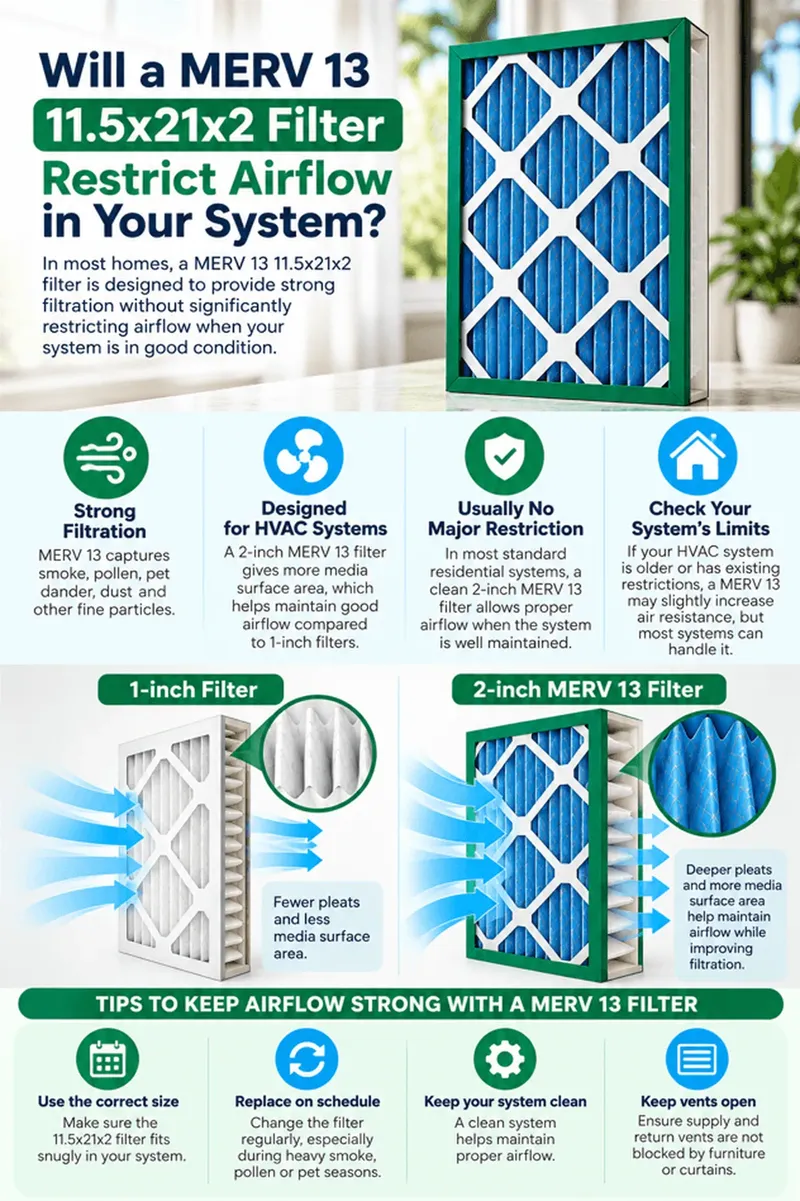
• Deeper pleats add surface area, so a 2-inch filter usually has lower pressure drop than a 1-inch filter with the same rating.
• Dust loading can sharply raise pressure drop, which makes change timing just as important as the MERV number.
• With roughly 1.68 square feet of face area, an 11.5x21x2 handles up to about 670 CFM at the recommended maximum air speed of 400 feet per minute.
Does MERV 13 Restrict Airflow in an 11.5x21x2 Filter?
It does, but usually not enough to harm a healthy system. Higher-MERV media packs its fibers more tightly so it can trap fine particles like smoke and bacteria, and that density creates pressure drop: the drag your blower has to overcome to pull air through the filter.
How much drag? The Department of Energy's Building America Solution Center puts filters rated MERV 7 to 14+ at roughly 0.05 to 0.3 in. w.c., depending on thickness and air speed. The same guide notes that the filter alone typically accounts for 20% to 50% of a system's total pressure drop.
How Does a 2-Inch Depth Change 11.5x21x2 Filter Pressure Drop?
Depth is where an 11.5x21x2 earns its keep. A deeper frame holds more pleated media in the same opening, so air spreads across more surface and moves through each square inch more slowly.
The Building America guide shows the effect with three MERV 7 filters from one manufacturer, each tested at 300 feet per minute:
• 1-inch filter: 0.20 in. w.c.
• 2-inch filter: 0.13 in. w.c.
• 4-inch filter: 0.12 in. w.c.
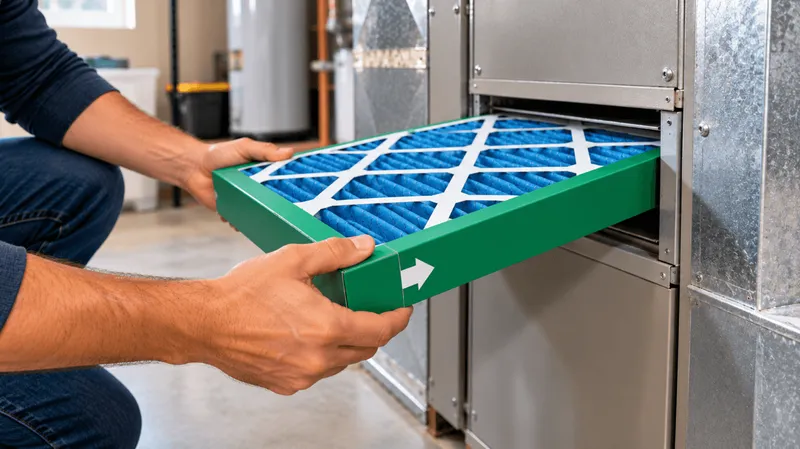
Going from 1 inch to 2 inches cut resistance by roughly a third, while doubling the depth again barely moved it. Keep in mind that "2-inch" is a nominal size. Filterbuy's 11.5x21x2, for example, measures 1.75 inches deep, so any filter in this size still needs to sit snugly in its slot. Even a quarter-inch fit error lets air bypass a 2-inch filter, and air that skips the media gets no benefit from the MERV rating.
What Static Pressure Is Safe for an 11.5x21x2 MERV 13 Filter?
Most residential HVAC systems run efficiently when total external static pressure stays at or below 0.4 to 0.5 in. w.c. That budget covers the ducts, coil, grilles, and filter together, so a filter that alone uses 0.25 in. w.c. can eat up half of a standard blower's available pressure, according to the Building America guide.
What happens next depends on your blower motor:
PSC (single-speed) motors slow down as resistance rises. Airflow drops, cycles run longer, and rooms feel less comfortable.
ECM (variable-speed) motors speed up to hold their target airflow. Air keeps moving, but the motor draws more power and works harder, which can shorten its life.
The only way to know your margin is to measure it. An HVAC technician can read total static pressure with a manometer in a few minutes, so ask for one reading with your current filter and another with the MERV 13 in place.
One trade-off most guides skip: your filter only cleans air while the blower runs, and the EPA says that's usually less than 25% of the time during heating and cooling seasons. Running the fan longer adds filtration, but it also keeps the blower working against the filter for more hours. That makes pressure margin even more valuable if you plan to run the fan more often.
Is One 11.5x21x2 Filter Big Enough for Your System's Airflow?
A filter's size matters as much as its rating. An 11.5x21 face measures roughly 1.68 square feet, and the Building America guide recommends keeping air speed through a residential filter between 200 and 400 feet per minute, with 500 as the upper limit.
Filter listings usually give you size and MERV but not airflow capacity, so I ran the numbers for this face area:
At 600 CFM (about a 1.5-ton system), air passes through at roughly 360 feet per minute, well within range.
At 800 CFM (about 2 tons), that climbs to roughly 480 feet per minute, close to the ceiling.
At 1,200 CFM (about 3 tons), a single 11.5x21x2 would see more than 700 feet per minute, too fast for any MERV rating.
My rule of thumb follows from that math: if your system is 2 tons or larger, check whether it has more than one filter slot. Two slots split the airflow and roughly halve each filter's load. You'll find the tonnage on the outdoor unit's data plate.
Is MERV 13 Too High for an 11.5x21x2 Filter?
For most homes with a properly sized system, no. The EPA's Guide to Air Cleaners in the Home says most furnaces and HVAC systems can run a MERV 13 filter without equipment problems as long as it's replaced frequently. It recommends at least MERV 13, or the highest rating your system fan and filter slot can accommodate.
MERV 13 makes the most sense if:
Someone in the home has allergies or asthma.
You deal with wildfire smoke or heavy outdoor pollution.
You have pets and notice dander buildup.
Your static pressure test shows room to spare.
MERV 11 is the better starting point if your system already runs near 0.5 in. w.c. with a lower-rated filter, if a single 11.5x21x2 carries more than about 800 CFM, or if regular filter changes are hard to keep up with. Filterbuy makes the 11.5x21x2 in MERV 11 as well, so stepping down doesn't mean changing sizes.
What Are the Signs of 11.5x21x2 Filter Airflow Problems?
A restricted filter usually announces itself. Watch for:
Weak airflow at supply registers, especially rooms farthest from the air handler.
Whistling at return grilles or around the filter door.
A filter that bows, buckles, or gets pulled out of its frame.
Longer run times or rooms that never quite reach the thermostat setting.
Ice on the indoor coil or refrigerant lines during cooling season.
A furnace that shuts off early on its high-limit switch during heating.
Start by pulling the filter. If it's loaded with dust, replace it. If it looks fairly clean and the symptoms continue, have a technician check static pressure and duct sizing.
How Often Should You Change a MERV 13 11.5x21x2 Filter?
Start with a 90-day schedule and adjust from there. The EPA notes that manufacturers typically recommend replacing filters every 60 to 90 days, and Filterbuy's guidance on its 11.5x21x2 page is tighter for some households: every 6 weeks with asthma or allergies, every 2 months with pets, and every 2 to 3 months with young children.
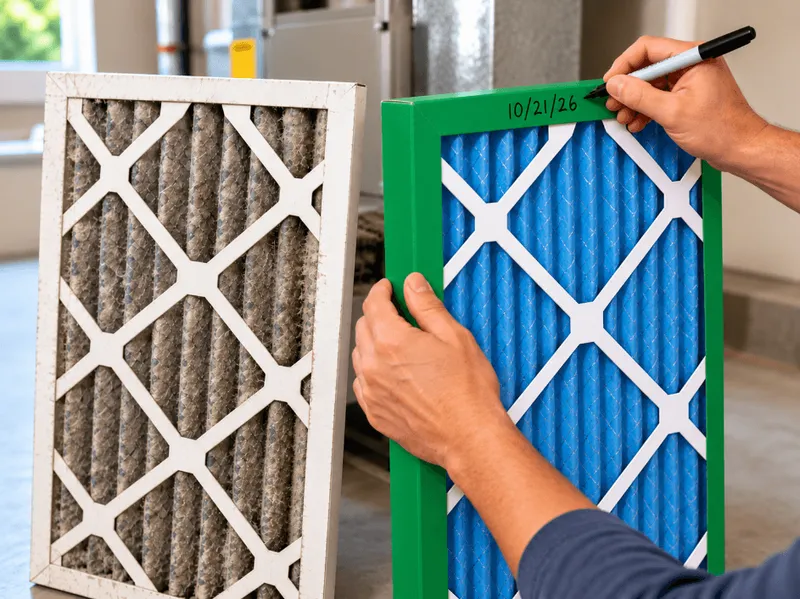
The habit I recommend is simple: write the install date on the filter frame and check your filter monthly. Once you can't see the filter's original color across most of the media, it's time for a new one.
How to Choose the Right 11.5x21x2 Filter for Your System
Before you buy, run through this four-step check:
Measure your slot's actual dimensions using this guide to measuring your old filter and slot.
Look up your tonnage on the outdoor unit's data plate and count your filter slots.
Multiply tonnage by roughly 400 CFM, then divide by the number of slots. Keeping each 11.5x21x2 under about 670 CFM holds air speed at or below 400 feet per minute.
If that check passes and your static pressure leaves room, go with MERV 13. If not, start with MERV 11.
Filterbuy is a U.S. air filter manufacturer that makes and ships HVAC and furnace filters direct to homeowners. Its 11.5x21x2 filter comes in MERV 8, 11, and 13, with an actual size of 11.5 x 21 x 1.75 inches, according to Filterbuy's 11.5x21x2 filter page. Because the actual size is listed, you can check it against your measured slot before ordering and avoid the air bypass that undercuts any MERV rating. The company has made and sold its filters in the U.S. since 2013.
Essential Resources on 11.5x21x2 Air Filters: 7 Guides to Choose, Fit, and Maintain Yours
1. Compare MERV 8, 11, and 13 in the Exact 11.5x21x2 Size
Filterbuy's 11.5x21x2 product page lists the filter's actual 11.5 x 21 x 1.75-inch dimensions and shows MERV 8, 11, and 13 side by side. Use it to match a rating to your household before ordering.
Source: Filterbuy's 11.5x21x2 air filter page
2. Confirm Your Furnace Can Handle MERV 13
The EPA says most furnaces and HVAC systems can use a MERV 13 filter if it's replaced often. Its guide also explains when to have a technician confirm your system's limit.
Source: EPA Guide to Air Cleaners in the Home
3. Know How Much Airflow a Higher MERV Rating Costs
The Department of Energy's Building America Solution Center explains static pressure limits, how blower motors react to resistance, and why deeper pleats lower pressure drop.
Source: DOE High-MERV Filters guide
4. Avoid the Quarter-Inch Fit Error That Lets Air Skip the Filter
This 2-inch sizing guide walks through what happens when a filter is a quarter inch off: unfiltered air slips around the media. The same lesson applies to an 11.5x21x2 slot.
Source: 11.25x11.25x2 vs 12x12x2 Air Filters
5. Measure Your Slot Before You Order
This guide explains nominal versus actual filter size and how to measure your old filter, which prevents gaps and forced fits.
Source: How to Find the Perfect Air Filter for Your HVAC System
6. Install Your Filter Right the First Time
The Department of Energy covers airflow-arrow direction, sealed access panels, and where filters belong in both easy-to-reach and hard-to-reach systems.
Source: DOE Proper Installation of Furnace and Air-Handler Filters
7. Catch a Clogged Filter Before It Chokes Airflow
A monthly visual check is the most reliable way to time replacements, and it matters more with MERV 13 filters, which can load faster.
Source: How Often Should You Replace Your 16x20x1 Air Filter?
Supporting Statistics: Why Your Filter's Airflow Matters
90% of time is spent indoors. Most of it is at home (EPA).
Your HVAC filter shapes the air you breathe most.
52% of home energy goes to heating and cooling. That was the U.S. average in 2020 (EIA).
A restrictive filter makes this biggest load work harder.
8.5% of adults and 6.3% of kids have asthma. Those are 2025 U.S. figures (CDC).
These homes gain the most from MERV 13, if static pressure allows.
Your Next Step
Start with three facts: your slot's measurements, your system's tonnage, and a static pressure reading from your next tune-up. With those in hand, you'll know whether MERV 13 is the right upgrade for your home. Have a question about your setup? Leave it in the comments below.
Frequently Asked Questions
Is a high MERV 11.5x21x2 filter safe for my furnace?
In most properly sized systems, yes. A clean 2-inch MERV 13 adds only modest resistance. If your furnace is older or already struggles to move air, confirm with a static pressure test first.
What is the pressure drop of an 11.5x21x2 MERV 13 filter?
It varies by brand, pleat design, and airflow, so check the label first. Since 2019, California has required filter labels to list pressure drop at several airflow rates, and the DOE advises skipping brands that won't publish it. For reference, filters rated MERV 7 to 14 typically fall between 0.05 and 0.3 in. w.c.
Can I put a 1-inch filter in an 11.5x21x2 slot?
No. A 1-inch filter leaves a gap that lets air bypass the media, and with less surface area, it often restricts airflow more than a 2-inch filter of the same rating.
Will a MERV 13 filter raise my energy bill?
Only slightly, and mostly when the filter is dirty or the system has little pressure margin. ECM blowers draw more power to hold airflow against resistance, while PSC systems may run longer cycles. A clean filter in a system with room to spare keeps any increase small.
Does a MERV 13 filter need to be changed more often?
Often, yes. A MERV 13 traps more fine particles, so it can load faster than a MERV 8. Check it monthly and replace it by 90 days at the latest, sooner with pets or allergies.
Glossary
MERV (Minimum Efficiency Reporting Value): A 1 to 16 rating from an ASHRAE test method that grades a filter's ability to capture particles from 0.3 to 10 microns, as the EPA explains in its MERV rating guide. Higher numbers capture more fine particles.
Pressure drop: The resistance a filter adds to airflow, measured in inches of water column (in. w.c.). Initial pressure drop is for a new filter; final pressure drop is for a loaded one.
Total external static pressure (TESP): The combined resistance of the ducts, coil, grilles, and filter that a blower must push against. Most homes are designed for 0.5 in. w.c. or less.
Nominal vs. actual size: Nominal size (11.5x21x2) is the rounded label; actual size (often 11.5 x 21 x 1.75 inches) is the true measurement used for fit.
Filterbuy: A U.S. air filter manufacturer that makes and ships HVAC and furnace filters direct to homeowners, including 11.5x21x2 filters in MERV 8, 11, and 13.
Learn more about HVAC Care from one of our HVAC solutions branches…
Filterbuy HVAC Solutions - Weston FL
2573 Mayfair Lane Weston FL 33327
(754) 296-3528
https://maps.app.goo.gl/E3tjmKf5VSWYghGc7


